
October 20, 2026
Niacinamide: An Ingredient That Earns Its Hype.
The science behind vitamin B3, brighter-looking skin, and why it belongs in First Light.
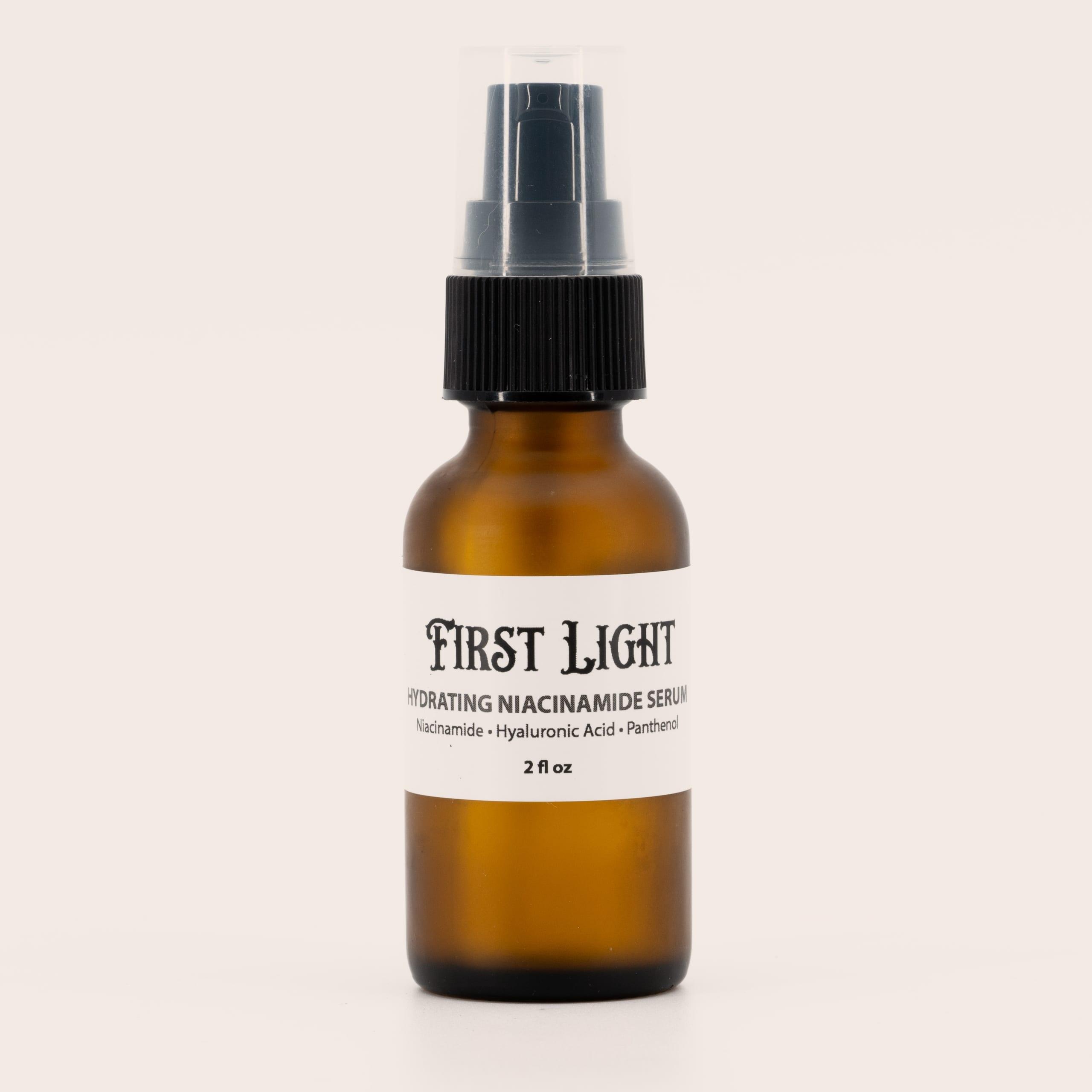
Every time I open Instagram, there's another miracle ingredient promising to erase wrinkles, shrink pores, and turn back the clock. My BS meter gets quite a workout.
But every once in a while, an ingredient comes along with some actual science behind it. Meet niacinamide.
What the heck is it?
Niacinamide is a form of vitamin B3. It's been studied in topical skincare for decades, and unlike many fashionable ingredients, it has clinical research supporting several of its benefits.
It helps support the skin's natural moisture barrier, which is particularly useful as our skin becomes drier with age. It can also improve uneven skin tone, reduce the appearance of some dark spots, and modestly improve fine lines and texture.
Show me the science.
In a 12-week, double-blind clinical study, 50 women ages 40–60 used a moisturizer containing 5% niacinamide on one side of their faces and the same moisturizer without niacinamide on the other.
The niacinamide-treated side showed measurable improvements in fine lines, uneven pigmentation, redness, and skin texture.
That's considerably more convincing than a before-and-after photo on Instagram.
But let's keep things in perspective. These were modest improvements over several weeks, not dramatic transformations. And while the research is encouraging, many studies are relatively small, with some conducted or funded by skincare manufacturers.
Why First Light?
I wanted First Light to be the kind of product that earns a place in your morning routine.
Niacinamide appealed to me because its benefits go beyond making skin feel temporarily softer. It has evidence for supporting the skin barrier and improving the appearance of uneven tone over time.
It's not an exfoliating acid, and it doesn't require an elaborate skincare routine. Most people tolerate it well, although sensitive skin can still react.
And here's something worth knowing: more isn't necessarily better. Much of the clinical research uses concentrations around 2–5%. A serum boasting 10% or 20% isn't automatically twice or four times as effective.
So where does it land on my BS meter?
Very little BS.
Niacinamide is one of the more credible multitasking ingredients in skincare. Its benefits are supported by actual clinical research, particularly for barrier support and improvements in skin tone.
What it won't do is erase deep wrinkles, lift sagging skin, or replace sunscreen.
My verdict: A hardworking ingredient with sensible benefits. That's exactly the sort of thing I want in First Light.
Good skincare doesn't need miracles. It needs good ingredients, used for good reasons.